Why does sea level change?
Recent contributions
Global warming from increasing greenhouse gas concentrations is a significant driver of
both increases in ocean mass and ocean thermal expansion as components of recent and future
sea level rise.
Ocean Thermal Expansion
From 1955 to 1995, earlier estimates of ocean thermal expansion is estimated to have
contributed about 0.4 mm/year to sea level rise, less than 25 per cent of the observed
rise over the same period. For the 1993 to 2003 decade, when the best data are available,
thermal expansion was estimated to be significantly larger, at about 1.6 mm/year for
the upper 750 m of the ocean alone, about 50 per cent of the observed sea level rise of
3.1 mm/year. Over the last few years we have been working hard on providing improved
estimates of ocean thermal expansion.
[top]
Contributions from non-polar Glaciers
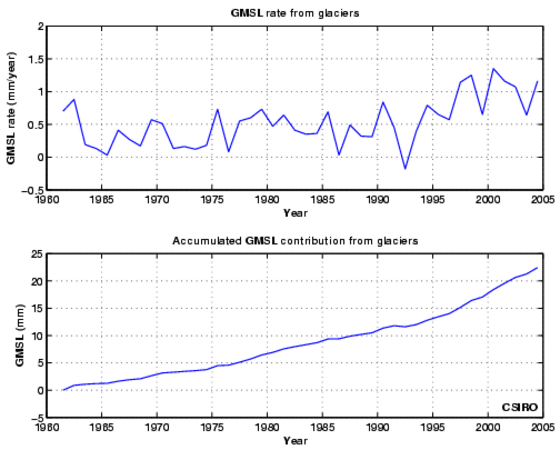
Kaser et al and others estimate the melting of glaciers and ice caps (excluding
the glaciers surrounding Greenland and Antarctica) contributed to sea level rise by about 0.4 mm
per year from 1961 to 1990 increasing to about 1.0 mm per year from 2001-2004. (Kaser, G.,
J.G. Cogley, M.B. Dyurgerov, M.F. Meier and A. Ohmura (2006), Mass balance of glaciers and ice caps:
Consensus estimates for 1961-2004, Geophysical Research Letters,
33, L19501, doi:1029/2006GL027511
Meier et al state that mass loss from glaciers is dominating the eustatic
component of sea level rise in the 21st century, providing 1.1 mm/year of the total eustatic
contribution of 1.8 mm/year in 2006. (Meier, M.F>, M.B. Dyurgerov, U.K. Rick, S. O'Neel,
W.T. Pfeffer, R.S. Anderson, S.P. Anderson and A.F. Glazovsky (2007), Glaciers Dominate
Eustatic sea level Rise in th 21st Century, Science,
317, 1064-1067
Dyurgerov and Meier glacier estimate.
The figure below shows the time series of glacier contributions to global sea level (top panel)
and the cumulative effect (bottom panel) from 1961-2004.
[top]
Contributions from the Ice Sheets
The ice sheets of Greenland and Antarctica have the potential to make the largest contribution
to sea level rise, but they are also the greatest source of uncertainty. Since 1990 there has
been increased snow accumulation at high elevation on the Greenland ice sheet, while at
lower elevation there has been more widespread surface melting and a significant increase in
the flow of outlet glaciers. The net result is a decrease in the mass of the Greenland ice
sheet - a positive contribution to sea level rise. For the Antarctic Ice Sheet, the uncertainty
is greater. There are insufficient data to make direct estimates for the preceding decades.
At present, the mass gain of the Antarctic Ice Sheet due to increased thickening of the East
Antarctic Ice Sheet does not appear to compensate for the mass loss due to the increased glacier
flow on the Antarctic Peninsula and the West Antarctic Ice Sheet. Modelling studies suggest that the Antarctic Ice Sheet is still responding to changes since the last ice age and that this may also
be contributing to sea level rise.
Antarctica
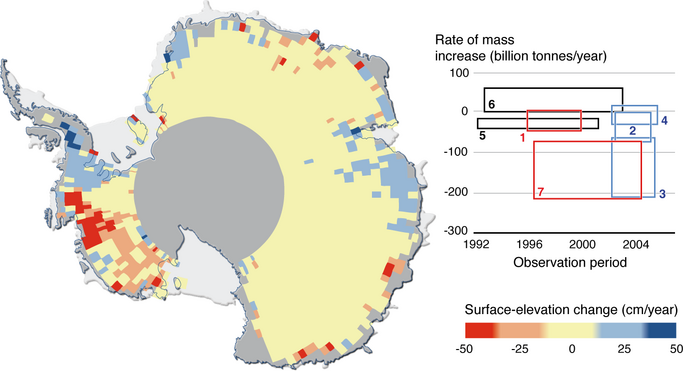
The
figure shows rates at which the ice-sheet mass was estimated to be changing
based on radar-altimeter data (black), mass-budget calculations (red), and
satellite gravity measurements (blue). Rectangles depict the time periods
of observations (horizontal) and the upper and lower estimates of mass balance
(vertical). Measurements by satellite techniques based on gravity indicate
mass loss at a rate of 138 ± 73 billion tonnes per year during
2002-2005, mostly from the West Antarctica Ice Sheet. That is equivalent to a rise in global
sea level of 0.4 ± 0.2 mm per year, or 10-30% of the global rate measured
since the 1950s, and is in good agreement with recent massbudget estimates.
However, two interpretations of satellite radar altimetry pointed to a
much smaller loss of about 31 billion tonnes of ice per year or a net gain
of about 27 billion tonnes per year. The difference between these estimates
from totally independent techniques reflects the uncertainties in these
difficult measurements; nevertheless, on balance, they indicate a recent
shift to a net loss of Antarctic ice and suggest that losses may be accelerating.
Similar conclusions result from studies of Antarctic Peninsula glaciers,
indicating that they are melting much faster than previously predicted
and are probably already contributing significantly to sea level rise.
Data sources (corresponding to numbers on rectangles)
1 |
Rignot, E. and Thomas, R. (2002). Mass balance of polar ice sheets.
Science, 297(5586), 1502-1506 |
2 |
Ramillien, G., Lombard, A., Cazenave, A., Ivins, E., Remy, F. and Biancale, R. (2006).
Interannual variations of the mass balance of the Antarctic and Greenland ice sheets from
GRACE. Global and Planetary Change, 53, 198-208 |
3 |
Velicogna, I. and Wahr, J. (2006). Measurements of time-variable gravity show mass loss
in Antarctica. Science, 311(5768), 1754-1756 |
4 |
Chen, J., Wilson, C., Blankenship, D. and Tapley, B. (2006). Antarctic mass rates
from GRACE. Geophysical Research Letters, 33, L11502 |
5 |
Zwally, H.J., Giovinetto, M.B., Li, J., Cornejo, H.G., Beckley, M.A., Brenner, A.C.,
Saba, J.L. and Yi, D. (2005). Mass changes of the Greenland and Antarctic ice sheets and
shelves and contributions to sea level rise: 1992-2002. Journal of Glaciology,
51(175), 509-527 |
6 |
Wingham, D., Shepherd, A., Muir, A. and Marshall, G. (2006). Mass balance of the Antarctic
ice sheet. Transactions of the Royal Society of London Series A,
364, 1627-1635 |
7 |
Rignot, E., Arthern, R., Bamber, J., van den Broeke, M., Davis, C., Li, Y., van de Berg,
W.J. and van Meijgaard, E. (2007). A net source of ocean mass from coastal thinning of
Antarctic glaciers. In print |
Source: UNEP: Global outlook for Ice &
Snow: Antarctica, showing rates of surface-elevation change derived from
satellite radar-altimeter measurements. (June 2007). In UNEP/GRID-Arendal Maps
and Graphics Library. Retrieved 01:43, August 28, 2007 from
http://maps.grida.no/go/graphic/antarctica-showing-rates-of-surface-elevation-change-derived-
from-satellite-radar-altimeter-measurements.
Greenland
Mass-balance estimates for Greenland show thickening at high
elevations since the early 1990s at rates that increased to about 4 cm per
year after 2000, consistent with expectations of increasing snowfall in a
warming climate. However, this mass gain is far exceeded by losses associated
with large increases in thinning of the ice sheet near the coast. Total loss
from the ice sheet more than doubled, from a few tens of billions of tonnes
per year in the early 1990s, to about 100 billion tonnes per year after 2000,
with perhaps a further doubling by 2005. These rapidly increasing losses result
partly from more melting during warmer summers, and partly from increased
discharge of ice from outlet glaciers into the ocean. In particular, the speeds
of three of Greenland's fastest glaciers approximately doubled since 2000,
although two of them have partially slowed since. The analysis has been derived
by comparing satellite and aircraft laser-altimeter surveys. The graph shows
rates at which the ice-sheet mass was estimated to be changing based on satellite
radar-altimeter surveys (black), airborne laser-altimeter surveys (green),
airborne/satellite laser-altimeter surveys (purple), mass-budget calculations
(red), temporal changes in gravity (blue). Rectangles depict the time periods
of observations (horizontal) and the upper and lower estimates of mass balance
(vertical). Jakobshavn, Helheim, and Kangerdlugssuaq are fast glaciers that doubled
in speed recently.
Data sources (corresponding to numbers on rectangles)
1 & 2 |
Krabill, W., Abdalati, W., Frederick, E., Manizade, S., Martin, C.,
Sonntag, J., Swift, R., Thomas, R., Wright, W. and Yungel, J. (2000). Greenland Ice
Sheet: High-Elevation Balance and Peripheral Thinning. Science,
289, 428-430
Krabill, W., Hanna, E., Huybrechts, P., Abdalati, W., Cappelen, J., Csatho, B.,
Frederick, E., Manizade, S., Martin, C., Sonntag, J., Swift, R., Thomas, R. and
Yungel, J. (2004). Greenland Ice Sheet: increased coastal thinning. Geophysical
Research Letters, 31, L24402 |
3 |
Thomas, R., Frederick, E., Krabill, W., Manizade, S. and Martin, C. (2006).
Progressive increase in ice loss from Greenland. Geophysical Research Letters,
33,
L10503 |
4 |
Zwally, H.J., Giovinetto, M.B., Li, J., Cornejo, H.G., Beckley, M.A., Brenner, A.C.,
Saba, J.L. and Yi, D. (2005). Mass changes of the Greenland and Antarctic ice sheets and
shelves and contributions to sea level rise: 1992-2002. Journal of Glaciology,
51(175), 509-527 |
5 - 7 |
Rignot, E. and Kanagaratnam, P. (2006). Changes in the velocity structure of the
Greenland ice sheet. Science, 311(5763), 986-990 |
8 & 9 |
Velicogna, I. and Wahr, J. (2005). Greenland mass balance from GRACE. Geophysical
Research Letters, 32, L18505
Velicogna, I. and Wahr, J. (2006A.) Acceleration of
Greenland ice mass loss in spring, 2004. Nature, 443, 329-331 |
10 |
Ramillien, G., Lombard, A., Cazenave, A., Ivins, E., Remy, F. and Biancale, R.
(2006). Interannual variations of the mass balance of the Antarctic and Greenland ice
sheets from GRACE. Global and Planetary Change, 53, 198-208 |
11 |
Chen, J., Wilson, C. and Tapley, B. (2006A). Satellite gravity measurements
confirm accelerated melting of Greenland Ice Sheet. Science,
313, 1958 |
12 |
Luthke, S., Zwally, H., Abdalati, W., Rowlands, D.D., Ray, R.D., Nerem, R.S.,
Lemoine, F.G., McCarthy, J.J. and Chinn, D. S. (2006). Recent Greenland mass loss by
drainage system from satellite gravity observations. Science,
314(5803), 1286-1289 |
Source: UNEP: Global outlook for Ice
& Snow: Greenland, showing rates of surface-elevation change between the late 1990s and
2003. (June 2007). In UNEP/GRID-Arendal Maps and Graphics Library. Retrieved 01:46, August 28,
2007 from
http://maps.grida.no/go/graphic/greenland-showing-
rates-of-surface-elevation-change-between-the-late-1990s-and-2003
[top]
|