Research
Biochemical Tracers Workshop
Held: 3 December 2008
Location: CSIRO Marine and Atmospheric Research, Hobart, Tasmania.
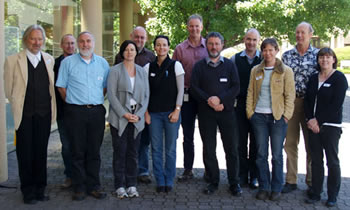
Speakers from the Workshop (Left
to right) Gustaaf Hallegraaf, Mat Vanderklift Stewart Frusher,
Cathy Bulman, Mark Hindell, Patti Virtue, Peter Nichols,
Tony Smith, Ed Butler, Michaela Guest, Jock Young and Lesley
Clementson.
Reports and papers from the Workshop
- Biochemical Tracers Workshop - Summary
Report [PDF 550Kb]
- Joanna Strzelecki:
Fatty acids from mesozooplankton of 34º to 22º S
parallel [PDF 588Kb]
- Gustaaf Hallegraaf:
Lipid biomarkers to diagnose algal bloom mediated fish
kills [PDF 2.3Mb]
- Michaela Guest:
Evidence of abalone diet from combined fatty acid and stable
isotope analysis [PDF 216Kb]
- Patti Virtue:
Biochemical tracer studies with krill: overwintering strategies
and key lipids determined for larval development [PDF 3.3Mb]
- Jenny Skerratt: (part i) A modeler’s perspective
and needs for Biochemical Tracers [PDF 3.1Mb]
- Cathy Bulman: (part ii) Biochemical tracers in ecological
modeling [PDF 2.6Mb]
- Ed Butler: Trace Elements as Tracers [PDF 724Kb]
- Rhys Leeming: Tracing nitrogen in food webs using compound
specific isotope ratio mass spectrometry [PDF 1.1Mb]
- Lesley Clementson: Pigment tracers in fisheries research [PDF 856Kb]
- Mat Vanderklift: How can stable isotopes inform fisheries
science [PDF 620Kb]
- Jock Young: SIA of top predators off eastern Australia [PDF 3.2Mb]
- Peter Nichols: Fatty acid profiling of top predators
off eastern Australia and in the southern ocean [PDF 1Mb]
- Rick Phleger: Signature Lipids of Deep Ocean Rattail
Fishes – a possible carrion diet? [PDF 350Kb]
- Stewart Frusher: Can molecular techniques be used as
cost-effective tools for understanding change in marine
ecosystems? [PDF 2.2Mb]
- Simon Jarman: The state of the art of DNA based dietary
analysis [PDF 2.3Mb]
- Mark Hindell: New insights into difficult animals: using
biochemical tracers in the foraging ecology of marine mammals [PDF 6.5Mb]
In early December, 2008, more than 50 people attended a workshop
on the applications and uses of biochemical tracers to inform
fisheries science and management. The workshop was held at
the CSIRO Marine and Atmospheric Research (CMAR) laboratories
in Hobart and participants included CMAR staff and colleagues
from academia and local government.
Attendees heard 17 presentations on biochemical tracers, including
stable isotopes, fatty acids, pigments, DNA and several others
under development. In addition, two of the presentations covered
modeling.
The study areas covered ecosystems from Antarctica and tropical
Australia, to the deep-sea off the California coast, and organisms
ranging from bacteria to seals.
The variety of applications of the different tracers was discussed,
but particularly noteworthy were those that contributed to understanding
diet and food webs, and to understanding how animals move around
in the ocean. The various approaches used by different research
organisations are also highly applicable to fisheries stock discrimination.
Following the presentations, workshop attendees participated
in an open discussion of the strengths and weaknesses of all
the approaches. Specific areas were highlighted where effort
needs to be focused and there was extensive discussion of the
potential to develop links with ecosystem models.
As a testimony to the strength and breadth of work conducted
in this area by CMAR, a recurring theme throughout the discussions
was the key developmental role that CMAR plays in this field
of research, including in the training of young scientists adept
with interdisciplinary methodology.
The presentations and workshop generated extensive discussion
of new ideas and possibilities for future collaboration. The
workshop organisers, CMAR's Dr Peter Nichols and Dr Mat Vanderklift,
will compile a summary report of the workshop's key findings,
in consultation with the presenters and other participants.

|


