Carbon dioxide and the carbon cycle
CSIRO Atmospheric Research Greenhouse Information
Paper
Global warming, or the enhanced greenhouse effect, is due to an increase
in greenhouse gases in our atmosphere, most notably carbon dioxide.
Atmospheric carbon dioxide concentrations have increased by 30% during
the past 200 years (Figure 1). The concentration today is almost 370 parts
per million (0.037%). Human activities such as burning of fossil fuels
and deforestation are responsible for the rapid increase in carbon dioxide
concentrations.
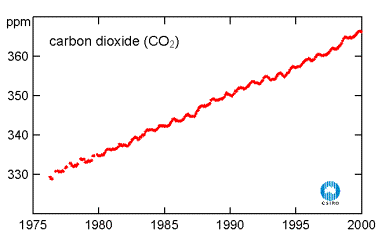
Figure 1. Atmospheric concentrations of carbon dioxide, measured at the
Cape Grim Baseline Air Pollution Station in north-western Tasmania.
Scientists are working to improve their knowledge of the circulation
of carbon between the atmosphere, the oceans, the land and the biosphere
(the carbon cycle, Figure 2) in order to assess the impact of human activity
on the cycle and the likely changes to climate that will follow.
This information paper examines the increase in atmospheric concentrations
of carbon dioxide and the role of the global carbon cycle.
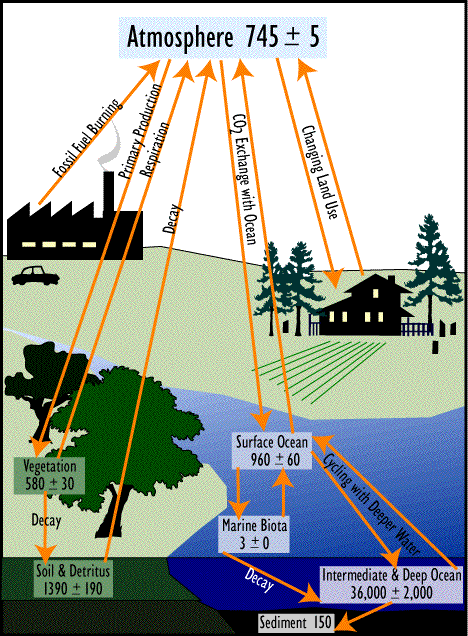
Figure 2: The global carbon cycle. Numbers represent the mass of carbon,
in gigatonnes of carbon (Gt C). (A gigatonne is a thousand million tonnes.)
Source: Wheeling Jesuit University/NASA (2000)
Currently, about 6.5 billion tonnes of carbon (as carbon dioxide) are
emitted each year during the combustion of fossil fuels and 1-2 billion
tonnes per year from land clearing.
About 3 billion tonnes of the carbon (as carbon dioxide) stays in the
atmosphere. The ocean takes up just over 2 billion tonnes. Terrestrial
sinks such as growing forests, which remove carbon from the air and store
it, take up the remaining 2-3 billion tonnes.
The enhanced greenhouse effect
Sunlight passes through the atmosphere, warming the Earth’s surface.
In turn, the land and oceans release heat, or infrared radiation, into
the atmosphere, thus balancing the incoming energy. Water vapour, carbon
dioxide and some of the other trace gases can absorb part of this radiation,
allowing it to warm the lower atmosphere, while the remainder is emitted
to space.
Atmospheric trace gases that trap heat are known as greenhouse gases.
About three-quarters of the natural greenhouse effect is due to water
vapour. The next most significant greenhouse gas is carbon dioxide.
Higher concentrations of carbon dioxide and other greenhouse gases in
the atmosphere will lead to increased trapping of infrared radiation.
The lower atmosphere is likely to warm, changing weather and climate.
The rise in atmospheric carbon dioxide
The global carbon cycle remained fairly unchanged for the 800 years before
the Industrial Revolution. The cycle has changed rapidly during the past
200 years.
Human activity is responsible for the rapid increase in atmospheric carbon
dioxide concentrations. Scientists know this from a range of evidence:
- Calculations of carbon dioxide emitted from fossil fuel combustion
(well-known from economic data) match measured variations of atmospheric
concentrations between the northern hemisphere and the southern hemisphere.
The biggest global sources of carbon dioxide are regions of peak fossil
fuel use.
- Atmospheric oxygen concentrations are declining slightly as carbon
in fossil fuels and plants combines with oxygen during combustion to
form carbon dioxide.
- Measurements of carbon isotopes, different forms of carbon, reveal
extensive release of carbon from fossil fuels.
Carbon sinks
As plants grow, they photosynthesise, removing carbon dioxide from the
atmosphere and converting it into organic compounds. Under ideal conditions,
1 million hectares of new forest could absorb about 25 megatonnes of carbon
dioxide each year. (A megatonne is a million tonnes.)
Because of so-called carbon dioxide fertilisation, carbon uptake by most
terrestrial plants will increase with increasing atmospheric carbon dioxide
concentration. However, this increase will be limited by environmental
factors such as availability of water and nutrients.
Higher temperatures will lengthen the growing season and increase carbon
uptake by plants in high latitudes, but will decrease carbon uptake by
tropical plants. The response to a changing environment is difficult to
quantify, particularly as the relative abundance of different types of
plants will change as the environment does.
Carbon dioxide fertilisation
Most crops and trees are expected to have higher productivity at higher
carbon dioxide concentrations, all other things being equal.
The extent to which those plants benefit from elevated carbon dioxide
concentrations depends on factors such as air temperature, rainfall and
soil nutrients. Studies in Australia and USA have shown that a forest
can initially increase productivity by up to 24% with a doubling of atmospheric
carbon dioxide. However, this productivity increase cannot be sustained
and will drop significantly as soil nutrients become limiting. Most Australian
soil is deficient in phosphorus, a deficiency that may counteract the
beneficial effect of higher carbon dioxide.
Recent research has concluded that agriculture in Australia will benefit
from higher temperatures and carbon dioxide concentrations only if crop
management strategies adapt to the changed climate. Studies at the UK
Hadley Centre suggest that the impact of climate change on tropical forests
may counteract and eventually reverse the impact of carbon dioxide fertilisation.
November 2000
|