CSIRO

Ocean Surface Currents and Temperature

News

July 13, 2010 The cyclonic eddy generated by STC "Ului" has now reached the northern GBR.
May 21, 2010 - update on STC "Ului". The cyclonic eddy generated by Ului in March has now [16 May], after 2 months, travelled half the distance from its origin to the coast. Strong northward currents north of Cairns can be expected as the eddy comes closer, as happened (even more so) in the aftermath to TC Andrew in [April 1997].
[old headlines]

Today's Maps

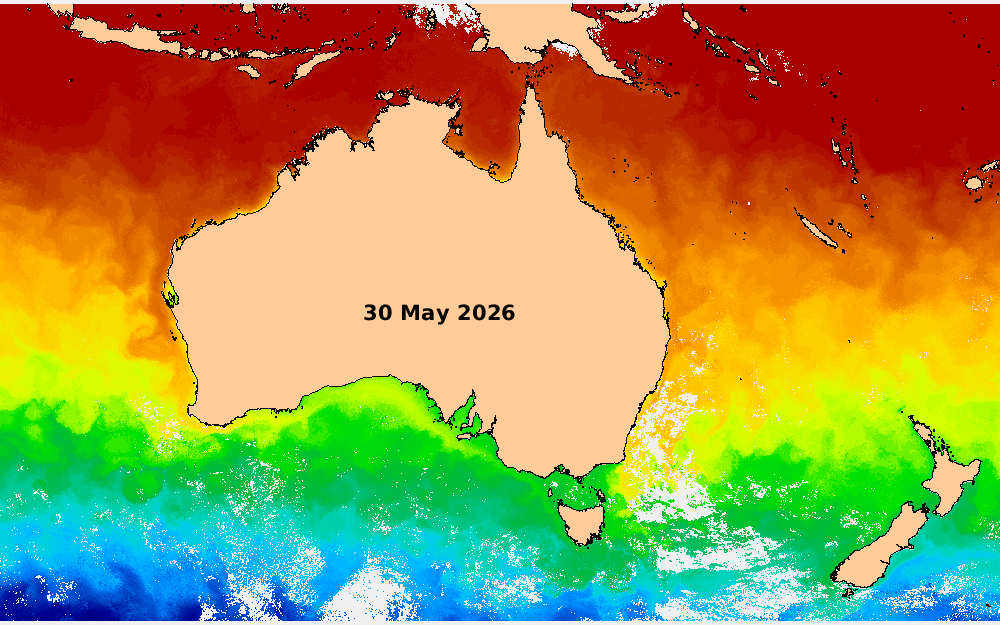
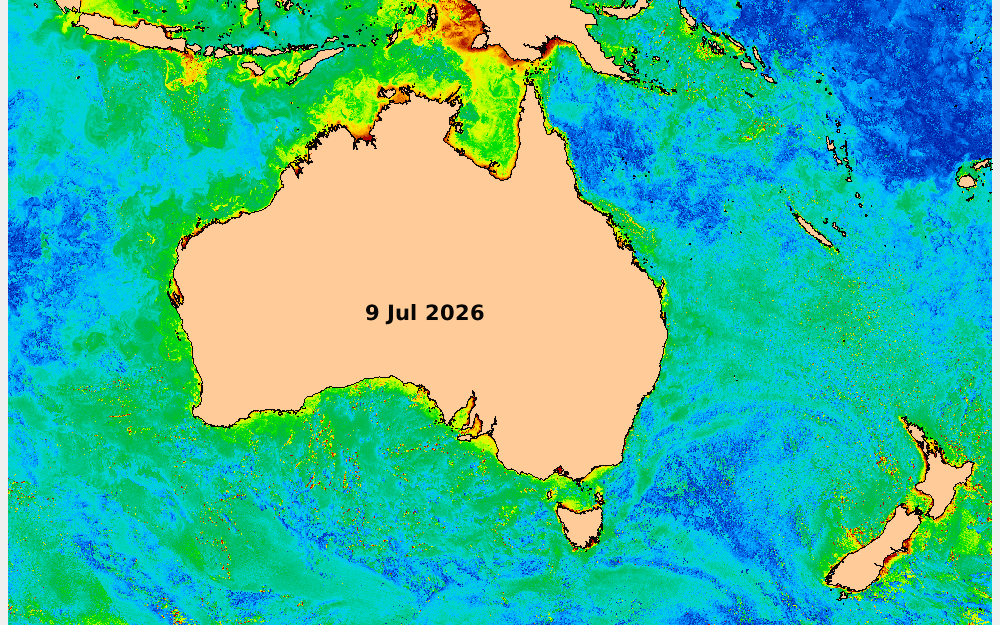
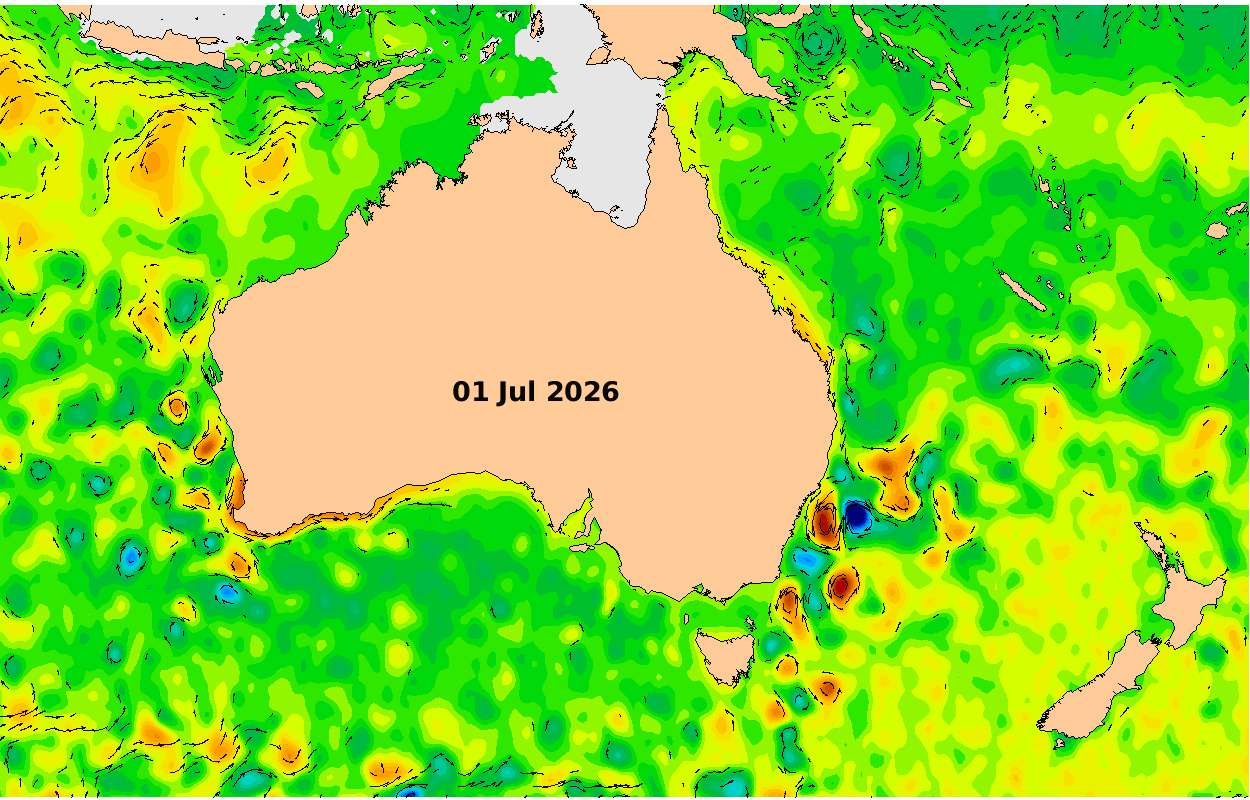
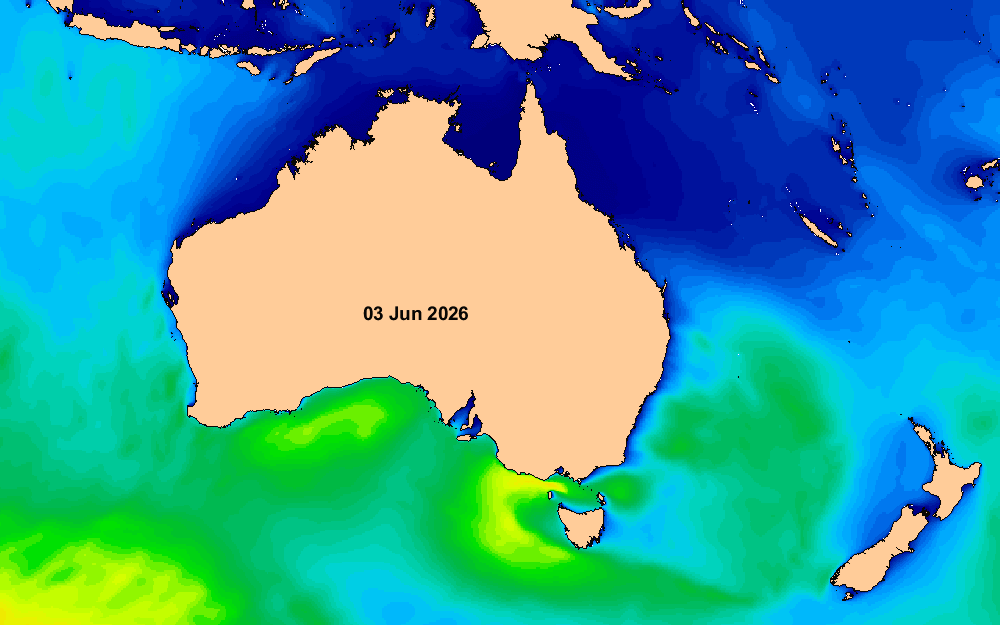
Select your region of interest to see the latest satellite estimates of ocean surface currents and temperature. The high-resolution imagery at left has the most up-to-date information, but the quality of the images is the most variable, due to cloud cover. To view the animations (accessed via the [DATE INDEX] link) you might need a fli movie player.

Ningaloo Perth Adelaide Syd-Hob Brisbane LordHowe SNSW NE NW SE SW GAB Australasia
[what's shown] [data sources] [access to data files]

GE [West Australia, with details for SW] [archive]
[East Australia, with details for SE] [archive]
Click one of these links and a map of the anomaly of 3-day average SST for WA or East Australia will appear in Google Earth. Drag the time slider right to see the most recent data. Zoom in to see 'snapshot' images of SST anomaly, overlain with altimeter-derived estimates of currents. Move the time slider slowly to load other days' data. Warning: You need very fast broadband for this to work well. Tip: Do not save this to My Places in GE. To refresh tomorrow, reload from the website.
The GE screenshot at left [expand] shows an ocean rower positioning himself to get a free ride with the current, as an example of how GE enables you to combine information from several sources.

At depth
[latest Argo float positions and temperature and salinity profiles to 2000m depth, compared with satellite-adjusted climatology)]

If you've found this information useful, please let us know. Your story helps make the case for sustaining the ocean observing system.


Previous years

Ningaloo Perth Adelaide Syd-Hob Brisbane LordHowe SNSW NE NW SE SW GAB Select your region of interest, or see our [3D panning animations].

[Project report: A Decade of SST] documents the production of the AVHRR datasets served here digitally and graphically.

[Do-It-Yourself graphics and data download]

Image and animation library

Australian region
[1993] [1994] [1995] [1996] [1997] [1998] [1999] [2000] [2001] [2002] [2003] [2004] 12-day Multisensor SST @6days [notes]
(1993) [1994] [1995] [1996] [1997] [1998] [1999] [2000] [2001] [2002] [2003] [2004] 12-day Multisensor SST anomaly @6days [notes]

Australasian region [1993] [1994] [1995] [1996] [1997] [1998] [1999] [2000] [2001] [2002] [2003] 10-day AVHRR SST anomaly @2days

Australian region
[1993] [1994] [1995] [1996] [1997] [1998] [1999] [2000] [2001] [2002] [2003] 3-day AVHRR SST anomaly @1day

Tropical Australian region
[1993] [1994] [1995] [1996] [1997] [1998] [1999] [2000] [2001] [2002] [2003] 6-day AVHRR SST @2days

Southern Ocean
[1993] [1994] [1995] [1996] [1997] [1998] [1999] [2000] [2001] [2002] [2003] 6-day AVHRR SST @2days

Southern Australia
[1990] [1991] [1992] [1993] [1994] [1995] [1996] [1997] [1998] [1999] [2000] [2001] [2002] [2003] 15-day AVHRR (Hobart only) SST @5days

Predecessors to this web site, focussing, respectively, on south-western and south-eastern Australia:


Headlines archive:
May 18, 2010 - update on Sydney: Beach water temperatures are still extremely high but the East Australian Current has now started to flow mostly away from the continental shelf at the latitude of Sydney, rather than towards the coast (as it has since late April), triggering the beginning of the end of the high temperatures. The explanation is faily complex: Between Sydney and Newcastle a clockwise-rotating, cold-core eddy has now become well established inshore of the EAC. Until the last few days, the EAC was flowing south around this cold-core eddy, feeding into a large pool of EAC water that is warmer than is normally seen off southern NSW at this time of year: [difference from average for 12 May]. The cold-core eddy has now grown so large that very little of the EAC is continuing south: most appears to be flowing offshore at the critical junction point at 34.5S, 152.5E: [imagery for 16 May]. To complete this eddy-shedding process, the cold-core eddy off Newcastle is likely to merge with the larger cold-core eddy to the SE, thereby completely separating the two masses of warm EAC water: the parent body to the NE, and the newly-shed body to the south. Update: The eddy shedding is now complete: [19 May]
[23MByte animation of 6-20 May]
April 29, 2010 - Beachtime for Sydney Swimmers at Sydney's beaches enjoyed water temperatures several degrees warmer than usual for a few days, courtesy of the East Australian Current coming very close to the coast at Sydney after flowing around a small cold feature off Newcastle.
[satellite imagery for 29 April] [23MByte animation].
March 25, 2010 Severe Tropical Cyclone "Ului" remained near 13S 159E from [15-18 March], allowing for much transfer of momentum to one region of the ocean. The low atmospheric pressure raised sea level but the induced cyclonic rotation reduced it. Once the cyclone moved on the cyclonic rotation and low sea level of the ocean remained: [20 March]. The SST imagery is not good but the reduction of temperature at the centre of the eddy can also be seen.
March 12, 2010 A major limitation of satellite altimetry is that sea level and ocean current maps made directly from it are valid for several days in the past, rather than just hours ago. Part of that latency is the time it takes for the satellites to cover all points on the globe. Another contributor is the time it takes for all the ground-segment computations to occur. It used to take several months to achieve the level of accuracy that is now achieved operationally in just a few days. Just recently, JPL announced availability of a new Jason-1 data product (OSDR-SSHA) with the same very-short latency of the Jason-2 GPS-OGDR. Inclusion of both these data products in our mapping has significantly improved the accuracy and timeliness of the maps. The histograms of data availability are your way of monitoring the amount of data going into the maps, a key factor in the resulting accuracy.
January 12, 2010 Retrieval of the first Seaglider to be deployed off Sydney. This mission lasted 85days, making many dives to 1000m, sampling the properties of a cold core and a warm-core eddy before returning to Sydney. FFI:[ANFOG]
December 20, 2009. Success! The Centaur has been found, proving that the survivors did indeed drift slowly north-eastwards (19nm over 34h is just 0.6kt) before being found where they were. It appears, therefore, that an eddy similar to the one NE of Cape Morton on [8 Dec 2009] must have been off Point Lookout on 14 May 1943. Had such an eddy not been there, and the flow more similar to how it was on [15 Oct 2009], survivors could have been swept as far south as Evan's Head, resulting in fewer being found if they became stretched over a larger area, or taken farther offshore.
December 16, 2009. Imagery off Brisbane has been very poor since the start of the search. [latest image]
December 8, 2009. The upwelled water off Fraser Island has become a cold-core eddy, around which the East Australian Current has been deviating. The flow is seen by animating a few high-quality SST images that weather conditions made possible on [8 Dec]. The (fairly rare) flow deviation is a welcome development for David Mearns who is searching for AHS Centaur.
December 4, 2009. Strong upwelling off Fraser Island has been caused by three factors: 1) the recent northerly winds, 2) a warm-core eddy driving very strong southward flow (with an onshore bottom Ekman layer) near the tip of Fraser Island, and 3) a westward-moving cold-core eddy centred at 26S 155E on 12 November causing uplift of the isotherms (see Argo profiles on 8 and 27 November).
October 1, 2009. IMOS Slocum Glider 106 launched off NSW: Mission: to sample the cold-core eddy off [Newcastle], then rendezvous with Southern Surveyor. [Australian National Facility for Ocean Gliders] April 9, 2009. Glider 109 retrieved after sampling the eddy. It travelled 710km in 23 days and made 1900 dives.
April 1, 2009. [Sarah Outen] leaves Perth, rowing to Mauritius. [Indian Ocean currents]
March 17, 2009. IMOS Slocum Glider 109 re-launched off NSW: Mission: to circumnavigate the cold-core eddy off [Newcastle], then return to the coast. [Australian National Facility for Ocean Gliders]
February 23, 2009. With the intercalibration with Jason-2 now complete, Jason-1 has been moved into a new orbit so the ground tracks interleave those from Jason-2, giving more observations so our maps can be more accurate. The last time there were two altimeters in an interleaved orbit was October 2005, the end of the Topex/Poseidon mission. The question now is how much longer Jason-1, launched in December 2001, will last.
December 15, 2008. Christmas Season notice: this website will be unmaintained for a longer-than-usual period this summer while staff are on leave. The systems should all continue working unattended but outages may occur. We apologise in advance for any interruption of service. We also apologise for the degraded accuracy of the velocity maps. This is a consequence of there only being two altimetry satellites useful for inclusion in the maps, rather than three or four in recent years. A return to three is scheduled to occur in early February 2009, when Jason-1 moves from inter-calibrating to interleaving Jason-2.
December 11, 2008. Glider 109 was successfully retrieved 40km off Jervis Bay after travelling 989km in 15days, an average of 0.76m/s, or 1.5kt. That's 10km on each alkaline 'c' cell! This economy was achieved principally by drifting with the current, and using the glider's 0.25m/s horizontal glide velocity to go sideways with respect to the currents, to get into water thought to be going in the desired direction. The satellite data posted here helped inform these choices, even though the data quality was low during much of the deployment due to heavy cloud cover depriving us of SST imagery, and there being only two altimeters presently useful for estimating currents. The glider's total velocity is the sum of the current (two estimates, one in black, one in magenta) and the glide velocity (shown in red), which is 0.25m/s in a chosen direction. Glider velocities overlain on satellite data:[start][1 Dec][end]. (sorry, the glider data is temporarily unavailable)
November 26, 2008. IMOS Slocum Glider 109 ('Nemo') launched. Mission: to circumnavigate the warm-core eddy off [southern NSW], then return to the coast. [Australian National Facility for Ocean Gliders] [Nemo kmz].
November 21, 2008. Sorry about the non-updating of this website over the last 2 weeks. We have been at an altimetry meeting and a software problem occured here.
October 21, 2008: Budget tightening in Europe and USA is threatening the continuity of space-based earth observations. Please consider supporting the IOC petition (before 30 October). If the up-coming Sentinel and Jason-3 missions are cancelled, this web site will cease to update when the existing Envisat and Jason satellites end their missions.
June 20, 2008: Launch of Jason-2 (OSTM). Watch this crucial event live on NASA TV. The launch window is 5:46-5:55pm Fri 20 June AEST. Commentary commences 2h before. [more]
November 28+, 2007: [BASE 3 Rowing Challenge] leaves Auckland. [SST and currents] [Possible routes]
November 14, 2007: [Crossing the Ditch] Two brave souls paddle across the Tasman Sea, with a little help from the East Australian Current and our Google Earth viewable maps of it.
August 2, 2007: BLUElink Ocean Forecasts become publicly available.
June-August, 2007: Cold-core eddy off Ningaloo: [animation of SST June and August]
March 21, 2007: Cold-core eddy off Sydney: [animation of SST March 14-15] [News item]

[Acknowledgements]

© Copyright 2010, CSIRO Australia
Use of this web site and information available from it is subject to our
Legal Notice and Disclaimer