Modelling climate change
CSIRO Atmospheric Research Greenhouse Information
Paper
Scientists use climate models to improve understanding of the Earth's
climate. The models are also being used to predict the impact on climate
of increasing concentrations of greenhouse gases.
This information paper describes climate models and points out their
strengths and weaknesses.
What are climate models?
Climate models are computer programs that simulate the processes that
govern the Earth’s climate. Global climate models contain four main
components: the atmosphere, the oceans, ice and snow covered regions,
and land surfaces with vegetation cover. It is these components and the
interactions between them that produce our climate.
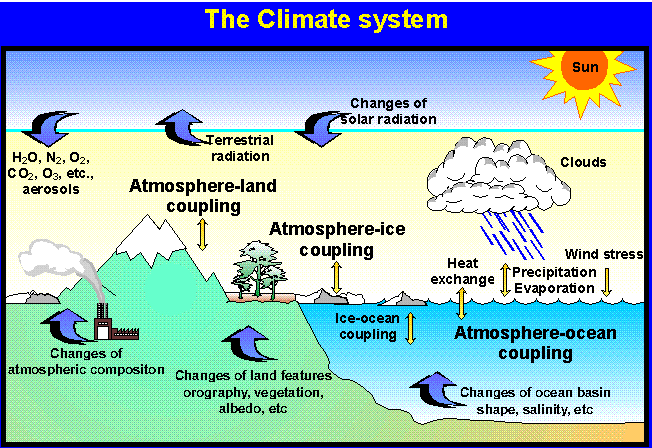
Climate models attempt to reproduce the way in which climate behaves
from day to day, from season to season and over the years. They need to
simulate conditions for all parts of the globe: at the surface, throughout
the atmosphere, and in the depths of the oceans.
Feedbacks in the climate system will affect the magnitude of climate
change. For example, warming will tend to reduce snow cover and so reduce
the amount of solar energy reflected back into space. This is an example
of a positive feedback because the extra energy absorbed increases the
warming. Climate models include these feedbacks.
Testing climate models
Evaluating the ability of models to simulate climate change is difficult.
Scientists can test climate models by running simulations of present-day
climate. However, the ability to simulate today’s climate is no guarantee
that a model will satisfactorily simulate future climate.
Researchers can also simulate past climates, such as the last Ice Age.
These simulations add to confidence in climate models.
It is only for present climate that there are enough observations for
extensive checking of climate models’ performance. Only the surface
temperature record is detailed enough for evaluation over the whole century.
How well do climate models perform?
When models simulate the climate by using only past greenhouse gas changes,
the results show surface warming greater than observed. When estimates
of the reflective effect of sulfate aerosol (tiny particles suspended
in the air, from natural or human-induced sources) are also incorporated,
models are better at matching both global average temperature changes
and the patterns of the changes to observations.
Including solar radiation changes, volcanic aerosol and stratospheric
ozone in models further improves the match between the simulation and
the observed record.
Many climate models satisfactorily reproduce the broad pattern of current
climate on Earth, over all regions and seasons. The models simulate phenomena
such as fronts, high and low pressure systems and monsoons. Model performance
has improved over the past decade, both in simulation of mean climate
and of important features such as El Niño. Regional climate is
less well simulated, and temperature variations are simulated better than
precipitation patterns.
Differences between modelled and real climate
The climate system is complex and models are imperfect; limitations of
climate models are due to three factors. Firstly, scientists still do
not understand perfectly all the processes that make up global climate.
Secondly, even the world’s best supercomputer does not have sufficient
power to simulate all the key factors that drive climate over every part
of the planet. Climate models must approximate processes that are on scales
too small to include explicitly, such as the formation of cumulus clouds
that may be only a few kilometres wide. Finally, there will always be
a limit to the extent that climate can be predicted.
Given the complexity of the global climate system, it is not surprising
that there are some discrepancies between the climate changes simulated
by models and actual observations. Scientists are overcoming these problems.
However, none of the discrepancies is sufficient to invalidate the finding
that rising greenhouse gas concentrations will lead to global warming.
Climate model simulations typically produce a warming for the period
1979-1998 that is slightly larger in the lower and mid-troposphere than
at the surface, in contrast to the trends observed by satellite instruments.
The difference may be partly due to reductions in stratospheric ozone,
and the stratospheric aerosol released by the 1991 Mt Pinatubo eruption
[see Information Paper on Volcanic eruptions and climate change]. However,
other observations that extend back further than 1979 show that the troposphere
has warmed only slightly less than the surface, in general agreement with
modelled findings.
During the past century, daily minimum temperatures over land have increased
at about twice the rate of maximum temperatures, leading to a decrease
in the day-night temperature range. Model simulations do not show such
a large decrease. Temperatures recorded at some high latitude stations
have not increased, in contrast to most simulations that generate large
warming at the poles. Given the limited measurements made in polar regions
and the small fraction of the globe they represent, it is not clear how
significant these differences are. Differences between model simulations
and observations suggest that there are other factors affecting the climate
that are not yet included in the models.
Confidence in projections
There is still considerable uncertainty in projections of possible climate
change, even for the global mean temperature. Much of this uncertainty
arises from the range of scenarios of future greenhouse gas and aerosol
emissions. These rely on various economic and social assumptions. A large
part of the uncertainty also arises from differing assessments of the
size of climate feedbacks. Feedbacks are treated differently in different
models, leading to variations in model sensitivity. However, the net climatic
impact of feedback processes is almost certainly positive. In other words,
feedbacks are likely to add to future global warming caused directly by
rising levels of greenhouse gases.
Global climate models do not have sufficient resolution to simulate climate
and climate change over sub-continental regions such as a specific Australian
State. To investigate local changes, researchers use regional climate
models, designed to run at fine resolution over small areas. Projections
of climate change are least accurate at regional levels but will improve
as more is understood about what affects the climate on these scales.
November 2000
|